Securely Split PDF Offline: 100% Private Guide
Published on March 20, 2026
In today’s digital world, managing PDF documents is a daily task for almost everyone, from students and freelancers to corporate professionals and legal experts. Often, you need to extract specific pages, separate chapters, or simply reduce a large document into smaller, more manageable files. The common solution? An online PDF splitter. But what if we told you that convenience often comes at a hidden cost: your privacy?
This comprehensive guide will delve into the critical importance of securely splitting PDFs offline, without ever uploading your sensitive data to a third-party server. We’ll explore the risks of online tools and introduce you to the gold standard of document processing: client-side, in-browser solutions like DumPDF, which prioritize your privacy above all else.
The Everyday Need to Split PDFs (and the Hidden Risks)
Splitting a PDF is a fundamental document management task with countless applications:
- Extracting specific sections: You might need to pull out a single report from a multi-chapter document, or share only the relevant pages of a contract.
- Reducing file size: Large PDFs can be cumbersome to email or upload. Splitting them into smaller chunks makes them more manageable. You can also securely compress your PDFs offline for optimal file sizes.
- Preparing for presentations: Separating slides or sections into individual files can streamline your workflow.
- Archiving and organization: Keeping related pages in separate files can improve document organization.
The problem arises when you turn to generic online PDF tools. While they promise quick solutions, their underlying mechanism often involves a significant privacy compromise: you upload your entire document to their servers.
Why Uploading Your PDF is a Major Security Risk
When you upload a PDF to an online service, you are essentially handing over a copy of your document to a third party. This opens up a Pandora’s box of potential privacy and security issues:
- Data Breaches: Servers are prime targets for hackers. If the online tool’s server is compromised, your uploaded documents could be exposed, stolen, or misused.
- Privacy Policies: Do you read every privacy policy? Many online tools reserve the right to store, analyze, or even share your data, often for “service improvement” or advertising.
- Compliance Violations: For professionals in legal, healthcare (HIPAA), finance, or government, uploading sensitive client or patient data to an unknown server can violate strict data protection regulations like GDPR, CCPA, and industry-specific compliance standards.
- Server Logs: Even if the service claims to delete your files immediately, server logs can retain metadata or even temporary copies of your documents, creating a digital footprint that persists.
- Lack of Control: Once your file is on someone else’s server, you lose direct control over it. You’re trusting a third party with your most sensitive information. For a deeper understanding of why offline PDF tools matter, explore our core privacy principles.
For anyone dealing with confidential contracts, personal health records, financial statements, academic papers, or proprietary business data, these risks are simply unacceptable.
The Gold Standard: Client-Side, Offline PDF Processing
Imagine a PDF tool that lets you split, merge, rotate, and manipulate your documents with all the convenience of an online service, but with none of the privacy risks. This is precisely what client-side, offline PDF processing offers.
What Does “Client-Side, Offline” Truly Mean?
Let’s break down these crucial terms:
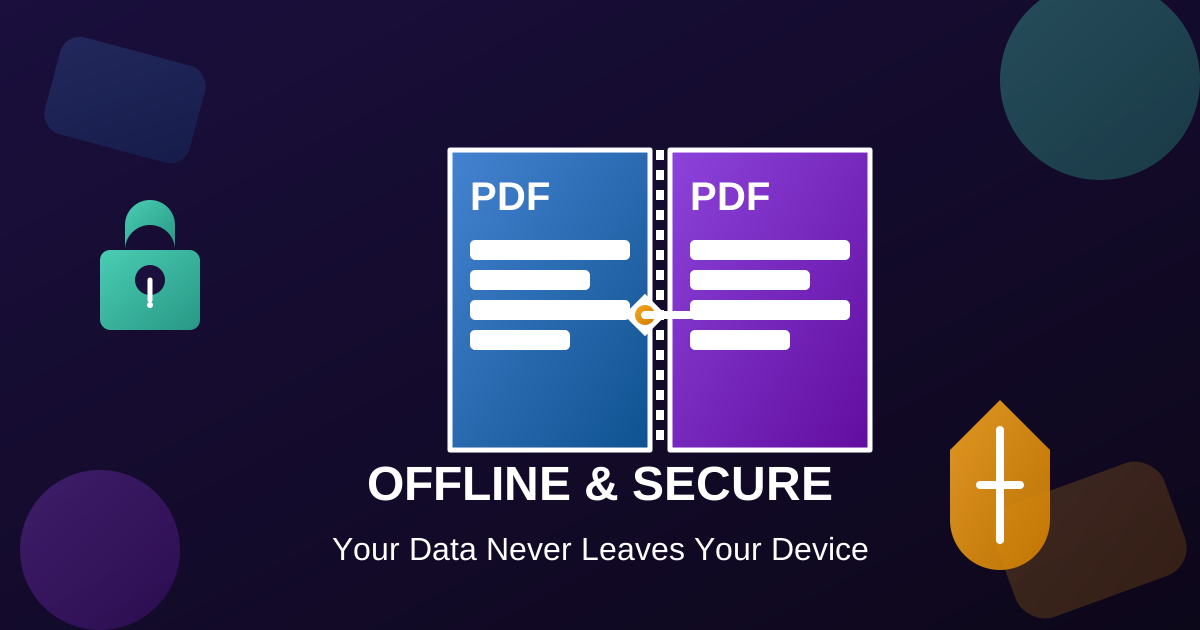
- Client-Side: This means all the processing – opening your PDF, performing the split, and generating the new files – happens directly within your web browser, on your computer. The data never leaves your device.
- Offline (during processing): Once the tool’s web page has loaded in your browser (which might require an initial internet connection), the actual PDF manipulation can often occur without an active internet connection. Your file is processed locally, not by a remote server.
The core benefit is simple yet revolutionary: YOUR FILES ARE NEVER UPLOADED.
Unpacking the Unrivaled Benefits of No Uploading
This “no upload” guarantee translates into a multitude of benefits for your security and privacy:
- 100% Privacy Assurance: Your documents remain exclusively on your device. There’s no server to snoop on, no third party to trust, and no data trail left behind.
- Zero Data Leaks: With no uploading, there’s no opportunity for your data to be intercepted during transit or exposed on a remote server.
- Enhanced Security: Your information is protected by your own device’s security measures. It’s not exposed to the vulnerabilities of an external server.
- Regulatory Compliance: For professionals, client-side processing can be a game-changer for meeting GDPR and HIPAA regulations, as sensitive data never leaves your controlled environment.
- Faster Processing: Since files are processed locally, you’re not constrained by internet upload speeds. Operations are much quicker for large files.
- Reliability and Control: You’re not dependent on a third-party server’s uptime. The tool works as long as your browser and device are functioning.
How DumPDF Achieves This Privacy Prowess
This level of privacy isn’t magic; it’s a testament to modern web technologies. Tools like DumPDF leverage powerful client-side JavaScript libraries and WebAssembly to perform complex PDF operations directly within your browser.
Here’s a simplified look at the process:
- Initial Load: When you visit the DumPDF website, the necessary code downloads to your browser. This is the only point where an internet connection is required.
- File Selection: You select your PDF file from your local storage.
- In-Browser Processing: Instead of sending the file to a server, your browser’s WebAssembly runtime opens and processes the PDF in your computer’s memory.
- Local Output: Once the split is complete, the new files are generated directly on your device. You download them to your preferred location without remote server interaction.
At no point does your actual PDF document ever travel across the internet.
Step-by-Step Guide: Securely Splitting a PDF with DumPDF Offline
Let’s walk through how exactly to use an offline PDF splitter tool:
1. Access the DumPDF Website
Open your web browser and navigate to the DumPDF homepage. The required application code will load immediately.
2. Select the “Split PDF” Tool
On the homepage, you’ll find various secure PDF utilities. Click on the “Split PDF” option to load the client-side module.
3. Upload Your PDF (Locally)
You’ll be prompted to select your PDF file by browsing your local computer or dragging the file into the upload zone. Crucially, your file is being opened by your browser and loaded into memory, NOT uploaded to DumPDF’s servers.
4. Define Your Splitting Options
Once loaded, you’ll see options to define how you want to split your file:
- Split by range: Extract specific pages (e.g., 5-10, 15, 20-22).
- Split every N pages: Create new PDFs every X pages (e.g., every 2 pages).
- Extract specific pages: Choose individual pages to save as separate documents.
5. Initiate the Secure Split
After setting your options, click “Split PDF”. The process occurs almost instantly right in your browser since no data travels over the internet.
6. Download Your New Files
Click the download button to save your newly split PDFs directly to your local computer.
Beyond Splitting: The Power of a Full Offline PDF Toolkit
The client-side, no-upload philosophy extends beyond just splitting PDFs. You can achieve complete document privacy across all workflows:
- Merging PDFs: Combine sensitive documents securely. Read our guide on how to securely merge PDFs holding private data.
- Extracting Text: Use local OCR to safely extract text and numbers from PDF receipts.
- Compressing PDFs: Reduce file size without sending content to a cloud-based optimizer.
A comprehensive offline PDF toolkit empowers you with total control over your documents, ensuring unparalleled security.
Summary
In an era where data breaches are rampant, choosing the right tools for document management is critical. Relying on online services that demand you upload your files is a gamble. Client-side, offline PDF processing tools like DumPDF offer a powerful, secure alternative. Make the switch to secure, offline PDF manipulation today and take control of your data.
Frequently Asked Questions (FAQs)
Is it safe to split a PDF online?
Generally, no. Uploading sensitive PDFs to generic online splitters exposes your data to external servers, increasing the risk of data breaches, interception during transport, and vague data retention policies. Using client-side offline tools ensures your data never leaves your device.
Can I split a PDF without uploading it?
Yes! By using an offline, client-side tool like DumPDF, your web browser utilizes its own computing power to process and split the document locally. The file is never uploaded to a cloud server.
Are offline PDF splitters faster than online ones?
Often, yes. Since offline PDF splitters process everything locally, they bypass the time required to upload a massive document over the internet and wait for a server queue, providing near-instant results for most splits.fe.
Help Keep DumPDF 100% Free & Private
Zero server uploads • No accounts • No trackers