Why Lawyers Must Use Offline PDF Tools for Client Privilege
Published on May 19, 2026
Quick Answer: Lawyers must use offline or client-side PDF tools because they process sensitive documents directly in the browser without uploading them to a server, ensuring that privileged information never leaves the local machine and remains protected from data breaches or third-party access.
In the legal profession, the sanctity of attorney-client privilege is the bedrock of trust. Every document, from a simple retainer agreement to complex litigation discovery, contains sensitive information that must be shielded from prying eyes. However, as the legal industry shifts toward digital-first workflows, a massive security hole has emerged: the reliance on cloud-based PDF processing tools.
While “free” online PDF converters and editors are convenient, they often come with a hidden cost—the privacy of your client’s data. For a modern law firm, the only way to guarantee 100% data sovereignty is to utilize tools that offer client-side, offline processing.
The Ethical Duty of Technological Competence
The American Bar Association (ABA) Model Rule 1.1, Comment 8, explicitly states that lawyers must maintain “technological competence.” This isn’t just about knowing how to use a computer; it’s about understanding the security implications of the software you use.
When you upload a confidential contract to a standard cloud-based PDF service, you are effectively transferring possession of that document to a third-party server. Even if the service promises to delete the file after an hour, that window of time is a vulnerability. If that server is compromised, or if the service’s internal data retention policies are opaque, you may be inadvertently violating your ethical duty to protect client confidentiality.
The “Cloud Trap”: What Happens to Your Uploaded Files?
Most popular PDF websites operate on a server-side model. Here is the typical workflow:
- You upload your file to their server.
- Their server processes the file (merging, splitting, or converting).
- You download the result.
- The file sits on their server until a cleanup script runs.
During this process, your data is at risk of being intercepted, cached, or even indexed. For a lawyer, “temporary storage” on a third-party server is an unacceptable risk. This is where the distinction between “online” and “offline/client-side” becomes critical.
Why Client-Side Processing is the Gold Standard for Privacy
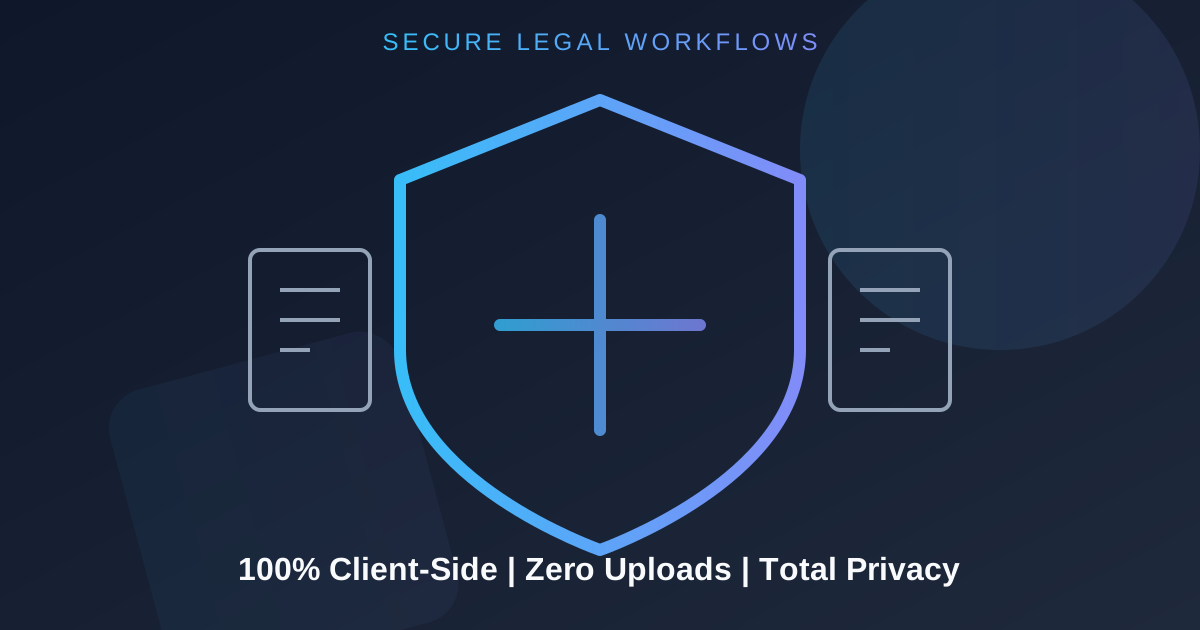
DumPDF operates on a fundamentally different philosophy: Privacy by Design. Unlike traditional tools, DumPDF uses advanced browser-based technology to process your files entirely on your own device.
When you use DumPDF to redact sensitive information, the file never travels across the internet to a central server. The “processing” happens in your browser’s memory. This means:
- Zero Data Leaks: Since there is no upload, there is no data in transit to be intercepted.
- No Server Storage: Your files are never stored on a third-party disk.
- Instant Results: You aren’t limited by your upload speed or server queues.
Essential PDF Workflows for Secure Law Firms
Legal professionals deal with high volumes of documentation that require precise manipulation. Using a secure, client-side tool allows you to perform these tasks without fear of a data breach.
1. Secure Document Assembly
During discovery, lawyers often need to merge discovery documents from various sources into a single, organized file. Doing this offline ensures that the cumulative weight of a case’s evidence isn’t sitting on a cloud server somewhere in another jurisdiction.
2. Redaction and Sanitization
Redaction is perhaps the most sensitive task a lawyer performs. Improper redaction (like drawing a black box over text in Word) is a common cause of data leaks. Using a dedicated PDF redaction tool that operates locally ensures that the metadata and underlying text are permanently stripped away before the document is ever shared.
3. Protecting Sensitive Disclosures
Before sending documents to opposing counsel or the court, applying strong encryption is standard practice. By using local tools to add passwords and permissions, you ensure that the “keys” to your documents are never exposed to a web server.
Compliance: GDPR, HIPAA, and Beyond
For law firms handling medical records (subject to HIPAA) or international clients (subject to GDPR), the stakes are even higher. These regulations demand strict control over where data is stored and who has access to it.
Using a server-side PDF tool often makes you a “Data Controller” sharing info with a “Data Processor” (the PDF website), which requires a Data Processing Agreement (DPA). By using a client-side tool like DumPDF, you bypass this complexity entirely. Because the data never leaves your machine, you aren’t “sharing” it with anyone. You maintain 100% control, simplifying your compliance audits and reducing your liability.
Speed and Reliability in the Courtroom
Lawyers often work under tight deadlines. Cloud-based tools are at the mercy of internet connectivity and server uptime. If you are in a courtroom or a location with spotty Wi-Fi and need to split a large PDF or rotate pages, a cloud tool might fail you.
Because client-side tools run in your browser using local resources, they are often significantly faster for large files. There is no waiting for a 100MB file to upload and download; the manipulation happens as fast as your computer’s processor can handle it.
Conclusion: Choosing the Right Tool
The digital age requires a new set of standards for legal security. Relying on “black box” cloud services for PDF manipulation is a risk that no modern law firm should take.
By switching to a client-side, offline-first approach, you protect your clients, satisfy your ethical obligations, and streamline your workflow. DumPDF provides the power of professional PDF tools with the absolute privacy of an offline application. Your files stay yours—always.
Help Keep DumPDF 100% Free & Private
Zero server uploads • No accounts • No trackers