Why Your Company Needs an Offline-First Document Policy
Published on June 22, 2026
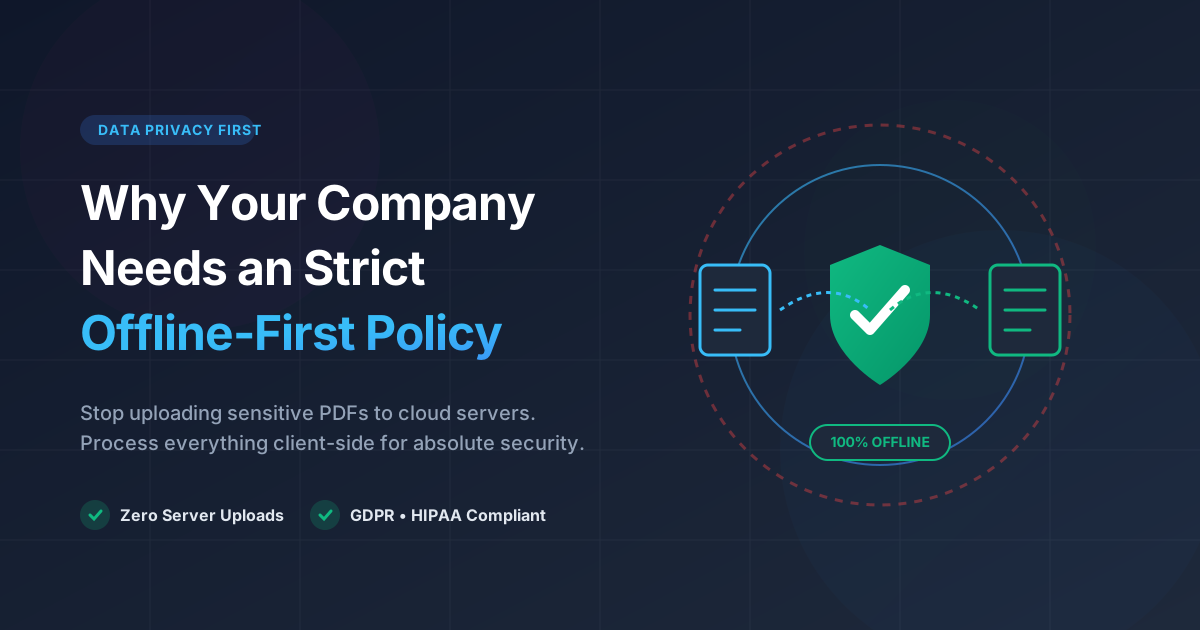
Quick Answer: An offline-first document policy protects sensitive corporate data by ensuring files are processed entirely client-side in the browser, eliminating the risk of server-side data leaks, compliance violations, and unauthorized third-party access.
In today’s hyper-connected business landscape, convenience often triumphs over security. Picture this common scenario: an employee needs to quickly combine three financial reports for an upcoming board meeting. They search for a “free PDF merger” on Google, click the first link, upload the highly confidential documents to a third-party server, download the combined file, and go about their day.
To the employee, this is a minor, productive task completed in seconds. To your Chief Information Security Officer (CISO), it is a compliance nightmare and a major data breach waiting to happen.
Every time a document is uploaded to an online converter or editor, your company loses control of that data. That is why progressive organizations are adopting a strict offline-first document policy. By shifting document manipulation to client-side, in-browser processing, companies can eliminate data leaks entirely while maintaining the speed and convenience employees crave.
The Hidden Dangers of Cloud-Based PDF Tools
Most “free” online PDF tools operate on a server-side model. When you upload a document, it is transferred to a remote server, processed there, and then sent back to your browser. While many reputable services claim to delete files after an hour, this workflow introduces several severe security vulnerabilities:
1. Data Retention and Terms of Service Traps
Have you ever read the fine print of free online tools? Many of these services fund their operations by collecting, analyzing, or even selling metadata. In worse cases, their terms of service grant them broad licenses to use uploaded content to train machine learning models or improve their services.
2. Server Breaches and Hackers
Even if a cloud provider has the best intentions to delete your files, their servers are lucrative targets for hackers. If a server is breached during the window when your sensitive document is stored, your proprietary IP, employee records, or client contracts could end up on the dark web.
3. Compliance and Regulatory Violations
Regulations like GDPR, HIPAA, CCPA, and PCI-DSS mandate strict controls over where personal data is stored and processed. Uploading a document containing personally identifiable information (PII) or protected health information (PHI) to an unvetted cloud server is a direct compliance violation that can result in catastrophic fines.
What is an Offline-First Document Policy?
An offline-first document policy mandates that all document manipulation, editing, and conversion must occur locally on the user’s machine.
Historically, this meant installing heavy, expensive desktop software like Adobe Acrobat on every employee’s computer. This approach is costly, difficult for IT departments to manage, and slows down older hardware.
Fortunately, modern web technology has evolved. Today, “offline-first” can be achieved directly within the web browser using client-side processing.
The Magic of Client-Side Processing
Using advanced web technologies like WebAssembly (Wasm) and modern JavaScript APIs, platforms like DumPDF allow users to perform complex PDF tasks entirely within their local browser.
When you use a client-side tool:
- Your files never leave your computer.
- No data is uploaded to a remote server.
- The browser’s memory (RAM) does the heavy lifting locally.
- You can even disconnect your internet entirely, and the tool will still work.
This approach combines the zero-install convenience of web apps with the absolute security of local desktop software.
Key Benefits of an Offline-First Policy
Implementing an offline-first policy is not just about avoiding disasters; it actively improves your operational workflow.
1. Absolute Data Privacy (Zero Leaks)
Because files are processed purely in-browser, there is no transmission medium for hackers to intercept. Man-in-the-middle (MITM) attacks become irrelevant because there is no data “in transit.” Your proprietary code, financial forecasts, and legal drafts remain 100% private.
2. Guaranteed Regulatory Compliance
With client-side processing, your compliance audits become significantly simpler. Since data never leaves the local machine, you do not have to worry about data residency laws, cross-border data transfers, or signing complex Business Associate Agreements (BAAs) with third-party PDF SaaS providers.
3. Superior Speed and No Bandwidth Bottlenecks
Server-side tools require you to upload large files, wait for the server to process them, and then download the results. If you are working with a 100MB document on a slow connection, this can take minutes. Client-side tools process files instantly at the speed of your local CPU, saving valuable time and bandwidth.
Practical Examples of Secure Offline PDF Operations
To understand how this works in practice, let’s look at two common workflows that traditionally pose high security risks, and how an offline-first approach mitigates them.
Securely Merging Financial Reports
When preparing quarterly or annual reports, departments often need to merge PDF files from various teams. These documents contain unannounced financial metrics, strategic plans, and sensitive projections. By using a client-side merger, the files are combined in the browser’s local memory. The resulting unified document is generated locally, ensuring the numbers remain strictly confidential until publication.
Redacting Confidential Information
Before sharing legal discoveries, contracts, or HR records externally, you must permanently redact PDF documents to obscure social security numbers, private addresses, or trade secrets. If done on a server-side tool, the unredacted version is exposed to the cloud. Doing this client-side ensures that the sensitive data is stripped out locally before the file ever touches the internet.
How to Implement an Offline-First Policy in 3 Steps
Transitioning your company to a secure, offline-first document culture is straightforward if you follow these steps:
Step 1: Audit Current Workflows
Identify the PDF and document tools your employees are currently using. Look for “Shadow IT”—unapproved free web tools that employees use out of convenience.
Step 2: Establish Clear Guidelines
Update your company’s IT security policy to explicitly forbid uploading company documents to unvetted server-side websites. Clearly define what constitutes “sensitive data” (which, in reality, is almost all corporate data).
Step 3: Provide Frictionless, Secure Alternatives
The easiest way to stop employees from using insecure tools is to provide them with a better, safer alternative. Bookmarking a client-side platform like DumPDF on all company browsers gives employees access to a suite of powerful, fast tools—including merging, splitting, compressing, and converting—without ever compromising corporate data security.
By making security as convenient as the alternative, your team will naturally adhere to the policy, protecting your organization from silent, devastating data leaks.
Help Keep DumPDF 100% Free & Private
Zero server uploads • No accounts • No trackers