Secure M&A PDFs Locally: The Ultimate Guide for Finance Pros
Published on May 26, 2026
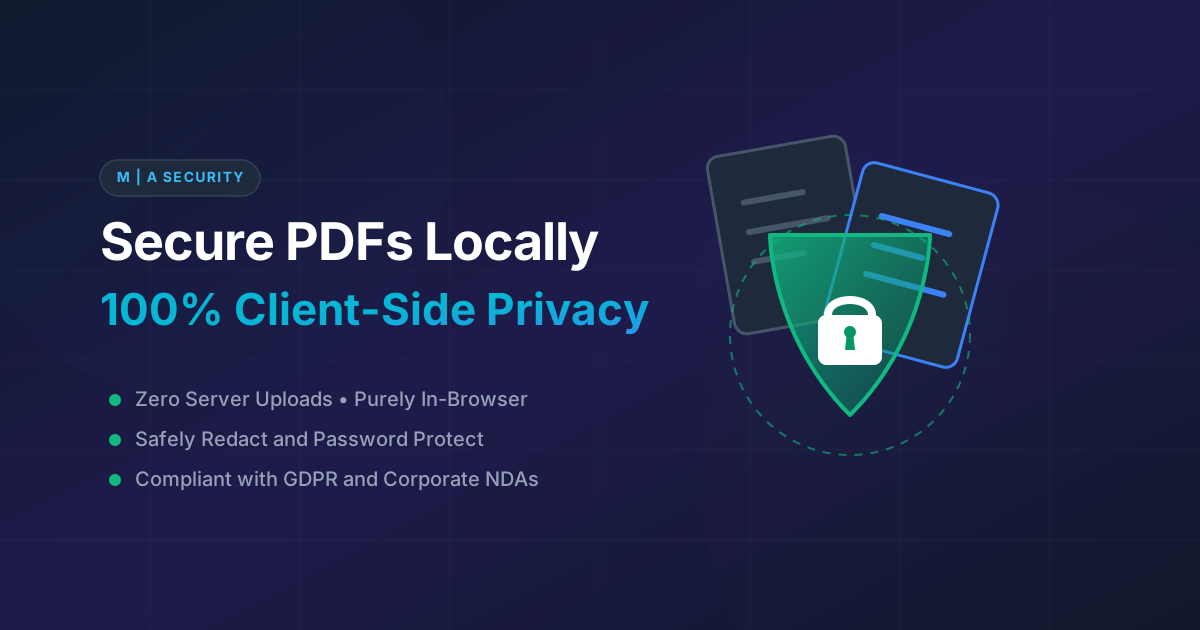
Quick Answer: Finance professionals can secure highly sensitive M&A PDFs by using client-side, local PDF tools that process documents entirely within the web browser. This offline-first approach ensures that confidential financial data is never uploaded to external servers, eliminating the risk of data leaks and compliance breaches.
In the high-stakes world of Mergers and Acquisitions (M&A), information is the most valuable—and vulnerable—currency. During a deal, financial analysts, investment bankers, and legal counsels handle an overwhelming volume of highly sensitive documents. Balance sheets, intellectual property filings, tax records, and employee rosters are routinely compiled, edited, and shared.
Most of these files exist as PDFs. While the PDF format is excellent for preserving layout and readability across devices, it presents a significant security challenge when it comes to editing, merging, or protecting these files.
Historically, professionals turned to convenient online PDF utilities to quickly format their files. However, conventional online tools pose a massive liability for M&A transactions. This guide explores why local, client-side PDF manipulation is the new gold standard for financial data security, and how you can protect your M&A pipeline from catastrophic leaks.
The Hidden Risks of Traditional Online PDF Tools
To understand the necessity of local processing, we must first look at how standard online PDF utilities operate.
When you use a typical “free online PDF editor,” the process looks like this:
- You upload your PDF to the provider’s remote cloud server.
- The server processes your document (e.g., merging, splitting, or converting).
- You download the processed file back to your machine.
While this seems harmless on the surface, it introduces three major vulnerabilities for M&A professionals:
1. The Server-Side Black Box
Once a document leaves your local network and travels to a third-party server, you lose all control over it. Even if a service provider claims to delete files “within one hour,” those files still exist on their disks, in their temporary caches, or in their server backups for a window of time. If that server is compromised, your proprietary M&A data is exposed.
2. Regulatory and Compliance Violations
M&A deals are bound by strict regulatory frameworks, including GDPR, CCPA, HIPAA, and stringent corporate non-disclosure agreements (NDAs). Uploading unencrypted, highly sensitive corporate data to an unauthorized third-party server can constitute a severe compliance breach, resulting in millions of dollars in fines, legal liabilities, and collapsed deals.
3. Man-in-the-Middle (MitM) Attacks
Data in transit is always more vulnerable than data at rest. Intercepting files as they are uploaded to or downloaded from a cloud-based PDF tool is a primary target for sophisticated corporate espionage actors looking to front-run stock movements or steal trade secrets.
The Solution: Client-Side, Local PDF Processing
To eliminate these risks, modern financial operations are transitioning to client-side, local-first web technologies.
But what exactly does “client-side” mean?
In a client-side architecture, the entire application runs directly inside your web browser (such as Chrome, Safari, or Firefox) using technologies like WebAssembly and JavaScript. When you select a PDF to edit, merge, or compress, the file is loaded into your computer’s local system memory (RAM).
The file never travels over the internet. It is never uploaded to a server.
The processing happens purely on your local CPU. Once the task is complete, the browser prompts you to save the newly generated file directly to your local storage. For all intents and purposes, your computer is acting as the server. This guarantees:
- 100% Data Privacy: No external entity ever sees or stores your documents.
- Zero Bandwidth Latency: Because files aren’t being uploaded or downloaded from the cloud, operations are nearly instantaneous—even for massive, multi-gigabyte financial audits.
- Offline Capability: You can perform complex PDF manipulations on a plane, in a secure vault, or in areas with zero internet connectivity.
Step-by-Step: Securing Your M&A PDFs Locally
When preparing documents for a Virtual Data Room (VDR) or sharing them with external stakeholders, you must follow strict security protocols. Here is how to execute these critical tasks safely using local-first tools.
1. Redacting Sensitive Information Safely
Before distributing financial statements or employee payroll details, you must permanently obscure personally identifiable information (PII) and proprietary figures. Simply drawing a black box over text in a standard PDF viewer does not delete the underlying data—it can easily be highlighted and copied.
To securely sanitize your files, you should redact PDF documents using a local-first editor. This process permanently strips the selected text and metadata from the document’s code directly in your browser, ensuring the redacted information can never be recovered by unauthorized parties.
2. Restricting Access with Strong Encryption
Unprotected PDFs sent via email are an open invitation for data interception. Before any document leaves your local machine, it should be encrypted with a strong password.
Using local tools, you can protect PDF files by applying robust AES-256 bit encryption. Because this encryption happens entirely on your local device, your master password is never transmitted to a remote server, keeping your access credentials completely private.
3. Assembling and Organizing Due Diligence Packages
M&A transactions require compiling hundreds of disparate files—tax returns, legal contracts, and operational audits—into cohesive packages.
When consolidating these files, you can safely merge or split documents locally. This ensures that as you compile highly classified corporate portfolios, the individual components and the final combined master file remain strictly on your local hard drive throughout the entire assembly process.
Why DumPDF is the Gold Standard for Finance Teams
For finance professionals who require absolute security without the bloat of heavy desktop software, DumPDF offers the perfect middle ground.
DumPDF is a suite of web-based PDF utilities designed with a strict privacy-first philosophy. Unlike traditional online PDF editors, DumPDF operates entirely on the client side.
- No Server Uploads: Your files never leave your computer. The browser acts as a secure sandbox.
- No Installation Required: You don’t need to get IT approval to install heavy, expensive desktop software. It works instantly in any modern web browser.
- No Account Needed: You can secure, merge, split, and redact documents immediately without creating an account or leaving an audit trail on an external platform.
- Enterprise-Grade Speed: Powered by modern web standards, DumPDF processes complex documents locally at speeds that rival desktop applications.
In the fast-paced, high-risk environment of M&A, a single leaked PDF can ruin years of strategic planning. By moving your PDF workflows to DumPDF’s local, client-side environment, you protect your clients, your deals, and your professional reputation.
Help Keep DumPDF 100% Free & Private
Zero server uploads • No accounts • No trackers