How Rating Agencies Protect Market Data via Offline PDF
Published on May 25, 2026
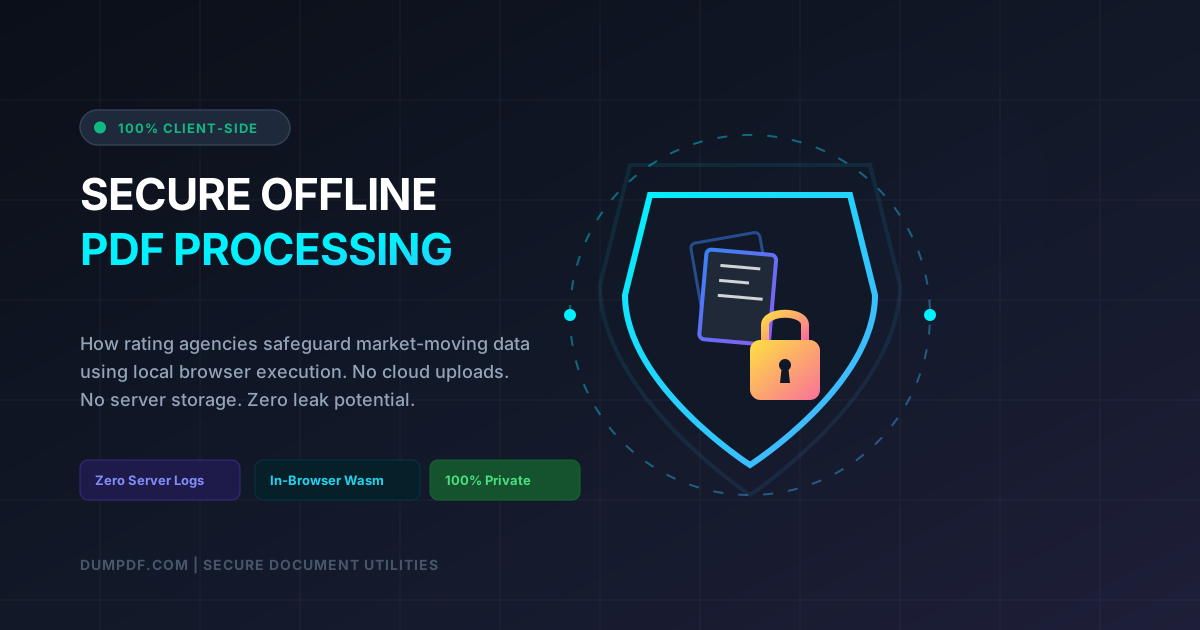
Quick Answer: Stock rating agencies protect highly sensitive pre-release market data by utilizing client-side, offline PDF processing tools that manipulate documents entirely in the local browser. This zero-server upload architecture guarantees 100% data privacy, eliminating the risk of interception, server-side hacks, or accidental data leaks.
In the financial world, information is the ultimate currency. A premature leak of a stock upgrade, a corporate credit downgrade, or a pre-market earnings report can shift billions of dollars in seconds, trigger regulatory investigations, and destroy institutional reputations.
For stock rating agencies and financial advisory firms, managing pre-release market data is a high-stakes balancing act. These organizations must compile, format, review, and secure thousands of PDF reports daily. However, using standard cloud-based PDF utilities poses an unacceptable security risk.
To combat this, leading financial analysts are turning to offline, client-side PDF processing. By keeping sensitive documents entirely within the local user environment, agencies can format and secure their reports without ever uploading a single byte of data to an external server.
The High-Stakes World of Pre-Release Market Data
Before a stock rating or corporate evaluation goes public, it exists as highly confidential draft data. Investment analysts, compliance officers, and editors work round-the-clock to compile these reports. The contents typically include:
- Credit rating changes (upgrades or downgrades) of major public corporations.
- Target price adjustments and detailed valuation models.
- Merger and acquisition (M&A) predictions backed by proprietary research.
- Regulatory compliance filings awaiting official submission dates.
If this data is intercepted or leaked even five minutes before the official release, it can lead to insider trading, unfair market advantages, and massive fines from regulatory bodies like the SEC. Consequently, the document pipeline must be fortified at every stage—especially during the final PDF preparation phase.
The Hidden Vulnerability: Cloud-Based PDF Tools
Many professionals routinely use free online PDF tools to merge drafts, split chapters, or compress files. While convenient, traditional online PDF converters operate on a server-side model.
Here is what happens when you use a typical cloud-based PDF tool:
- Upload: Your document is sent over the internet to a third-party server.
- Processing: The server processes the PDF (e.g., converting, compressing, or merging).
- Storage: The file is stored temporarily (or sometimes permanently) on that server before you download it.
For an everyday user, this might be a minor risk. For a stock rating agency handling market-moving intelligence, it is an absolute dealbreaker. Cloud servers can be breached, employee credentials can be compromised, and data retention policies of third-party tools are often vague. If a draft PDF containing an upcoming stock downgrade is cached on an unsecured cloud server, the agency faces a catastrophic liability.
How Offline PDF Processing Eliminates Leak Risks
To eliminate the vulnerabilities of cloud uploads, modern security-conscious enterprises utilize client-side, offline PDF processing.
Tools built on this architecture—such as DumPDF—leverage advanced browser technologies like WebAssembly (Wasm) and local JavaScript APIs. Instead of sending your file to a remote server, the web browser itself acts as the processing engine.
[Your PDF File]  --->  [Processed Locally in Browser (WebAssembly)]  --->  [Saved Directly to Device]
                                   ^
                     (0% Server Upload | 100% Offline)
When you import a document, the processing occurs entirely within your computer’s RAM. The file never leaves your local machine, ensuring:
- Zero Data Leaks: Because there is no server upload, there is no data in transit to intercept.
- Absolute Privacy: No third party can ever view, store, or analyze your sensitive financial figures.
- Compliance Adherence: It easily aligns with strict data protection mandates such as GDPR, HIPAA, and financial industry standards (SOC 2, FINRA).
Core PDF Workflows in Financial Rating Agencies
Before a financial report is cleared for public consumption, it undergoes several structural and security modifications. Offline tools allow analysts to perform these tasks safely.
1. Redacting Sensitive Metadata and Draft Notes
During the editorial phase, PDFs often accumulate internal comments, author metadata, and historical edit trails. Before publication, compliance teams must redact PDF files to permanently strip out sensitive background information, ensuring only the final, approved text is visible to the public. Doing this offline ensures that the redacted data is destroyed locally and never cached on an external server.
2. Securing Reports with Strong Encryption
Once a report is finalized, access must be strictly controlled until the exact second of release. Analysts use offline tools to protect PDF documents with strong AES-256 encryption and passwords. Encrypting the file locally guarantees that the password and the unencrypted source file are never exposed to external web traffic.
3. Assembling and Structuring Multi-Page Reports
Financial analysts often compile data from various departments—macroeconomic researchers, industry specialists, and quantitative analysts. They must merge multiple charts, tables, and text summaries into a cohesive report. Using local, browser-based tools, they can merge, split, and reorder pages instantly without waiting for slow server uploads or worrying about data exposure.
Why Client-Side In-Browser Processing is the Future
The shift toward client-side processing represents a massive leap forward for digital privacy. Organizations no longer have to choose between the convenience of web-based tools and the security of heavy, expensive desktop software installations.
| Feature | Traditional Cloud PDF Tools | Client-Side Offline Tools (DumPDF) |
|---|---|---|
| Data Transfer | Uploads file to external server | 100% Local (In-Browser) |
| Data Leak Risk | High (Server hacks, data caching) | Zero (No data leaves your device) |
| Processing Speed | Dependent on internet upload speed | Instant (Powered by your local CPU) |
| Offline Capability | Non-existent (Requires active internet) | Works completely offline |
| Installation | None required | None required |
By utilizing browser-based WebAssembly, tools like DumPDF deliver the speed of desktop applications with the zero-install convenience of a website, all while maintaining an ironclad security posture.
Choosing the Right Offline Tools for Your Workflows
Whether you are a financial analyst protecting market-moving reports or an everyday user handling private tax documents, your data deserves the highest level of security.
When choosing a PDF utility, always verify its privacy policy and technical architecture. If a tool requires you to upload your document to “the cloud” for processing, think twice about the sensitivity of the information you are submitting.
By adopting a client-side, offline-first approach, you can edit, merge, split, and secure your files with absolute confidence, knowing that your private data remains exactly where it belongs: on your device.
Help Keep DumPDF 100% Free & Private
Zero server uploads • No accounts • No trackers